Search for "MLP AI," and you will hit a massive fork in the road. It means two entirely different things, requiring clear disambiguation.
One framework runs your machine learning models. The other framework creates your fan fiction. We cover both paths below.
You typed "MLP AI" into the search bar. You were looking for one of two things. The algorithm, or the fandom.
It constitutes a classic case of acronym collision. In the high-stakes world of artificial intelligence, MLP stands for Multilayer Perceptron. It forms the bedrock of modern deep learning and operates as a mathematical powerhouse.
But on the creative web, it stands for something entirely different. My Little Pony AI. This massive subculture leverages generative AI to build art, clone voices, and expand a beloved universe.
Two entirely separate worlds share one search term. Whether you need to understand how data moves through a neural network or how to generate a perfectly stylized pony avatar, you are in the right place.
Let's break down both definitions of MLP AI.
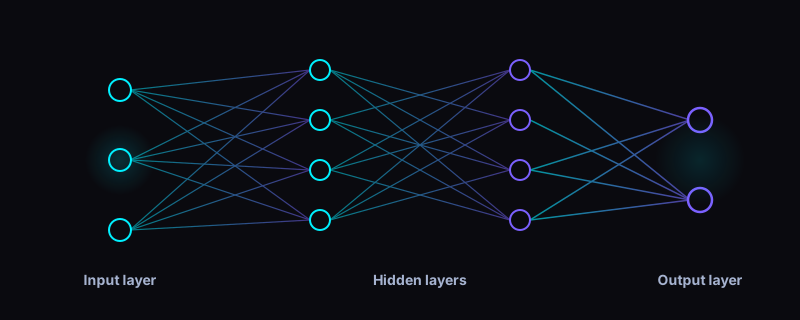
Strip away the hype of modern AI, and you will find the multilayer perceptron AI. This acts as the workhorse of data science.
An MLP neural network is a class of feedforward artificial neural network (ANN). It solves complex, non-linear problems efficiently. Think of it as the foundational machine learning algorithm that paved the way for the deep learning models we rely on today.
It all comes down to layers. A standard MLP neural network operates across three distinct stages.
Data only moves in one direction. Forward. From input to output.
That makes it a feedforward network. It trains using backpropagation, constantly tweaking internal weights to reduce errors and improve accuracy.
Versatility. Power. Reliability.
MLP machine learning models excel at pattern recognition. Engineers deploy them when standard linear models fail. You will find multilayer perceptron AI driving complex classification tasks.
They predict financial trends, power speech recognition, and approximate intricate mathematical functions.
These networks are computationally heavy, but incredibly effective. If a problem is non-linear and requires deep pattern extraction, the MLP neural network remains the tool data scientists trust.
Now, we pivot. Away from data science. Into digital creativity.
In fandom communities, "MLP AI" refers exclusively to My Little Pony AI. Fans hijack the power of generative models to build tools specifically trained on the colorful, stylized world of Equestria.
It represents a massive internet trend. Creators use a My Little Pony AI generator to push the boundaries of fan-made content.
Visual generation drives the core of this movement. Fans train customized AI models—often using Stable Diffusion and specialized LoRAs—to perfectly replicate the show's distinct art style.
The result? Stunning MLP AI art generated in seconds.
Users type in a prompt. They describe their original character (OC). The AI art generator outputs a flawless, high-resolution image.
This technology revolutionizes fan art. It allows anyone to bring their unique pony concepts to life, regardless of their drawing skills.
But it does not stop at images. The fandom fully embraces audio generation. Enter the MLP AI voice cloning phenomenon.
Using advanced vocal synthesis, creators train AI to mimic the exact tones, inflections, and speech patterns of iconic characters. It sounds uncanny.
Fans use these MLP AI voice tools to generate dialogue for fan-made animations. They create audio memes. They even produce original songs sung by AI-cloned voices.
It serves as a powerful, highly entertaining use of audio deep learning.
Two distinct worlds share one powerful acronym.
If you are a developer, a data scientist, or an AI enthusiast, your journey continues into the architecture. You need to dive deeper into activation functions, backpropagation, and building your own MLP neural networks.
If you are a creator, an artist, or a fan, your next step is exploring the tools. You need to find the best My Little Pony AI generator or test out the latest voice cloning software.
Choose your path. The machine learning algorithms and the AI art are both waiting.