This article was produced with AI assistance. Editorial standards apply — see our About editorial process.

Key takeaways
- AI agent vs chatbot is a control split: agents act toward a goal across tools; chatbots typically answer in conversation.
- NIST’s agentic AI page: autonomous agents that independently make decisions, learn from interactions, and adapt; goal-driven behaviour; dynamic interaction with users, systems, and real-world scenarios.
- NIST ITL’s evaluation-probes project: agents plan multi-step tasks and autonomously take actions such as using tools and searching databases. Users need a trail of reasoning, tool use, and evidence.
The control split
AI agent vs chatbot is a control split: NIST describes agentic AI as autonomous, goal-driven systems that interact with users and other systems, while a chatbot typically stays in a conversational turn without that independent action loop.
NIST’s agentic AI page is the definition used here. Daily wrappers that sit on either stack are listed in AI assistants. Do not treat a marketing “agent” badge as a measurement result.
| Chatbot | Agent | |
|---|---|---|
| Primary loop | Conversational turns | Goal-driven actions across tools |
| NIST wording | Not the agentic-AI definition | Autonomous, goal-driven, interacts with users and systems |
| Audit need | The transcript is usually enough | Reasoning, tool use, and evidence trail (NIST probes project) |
Tools, plans, and audit trails
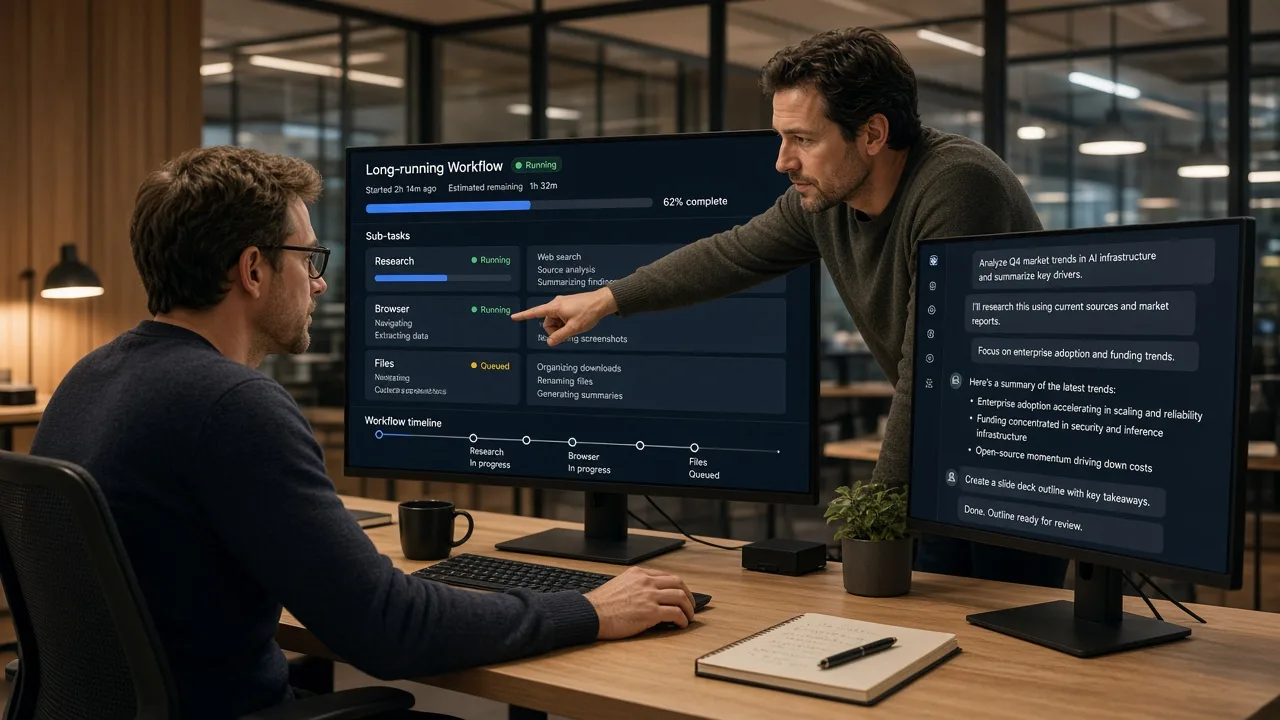
NIST ITL’s evaluation-probes project describes AI agents as capable of planning multi-step tasks and autonomously taking actions such as using tools and searching databases. The same page argues for visibility into reasoning, tool usage, and gathered evidence. That is the operational difference from a reply box.

Generative text models can power either interface. How generation differs from classification is on generative versus traditional AI. Shortcut lists that mix both live in productivity hacks.
When a chat box is enough
Keep a chatbot when the job is Q&A, drafting, or a scripted FAQ. Move to an agent when the job is a multi-step change in another system and you can name who reviews the trail. NIST’s 22 February 2026 Agent Standards Initiative announcement frames agents that work autonomously for hours, write and debug code, manage email and calendars, and shop—constrained by how well they interact with external systems.
Parent silo: AI Tools & Software. Cluster: Productivity & Workflows.
FAQ
What is AI agent vs chatbot?
NIST’s agentic AI page: autonomous, goal-driven systems that adapt and interact with users and systems. A chatbot typically returns conversational output without that independent action loop.
Is every chatbot an agent?
No. NIST’s probes write-up treats agents as planners that take tool actions. A FAQ bot that never leaves the transcript is not that.
Is agentic AI the same as AI agents?
Marketing uses both phrases. This page follows NIST’s agentic AI wording and the Agent Standards Initiative’s “agents capable of autonomous actions.”